Add your promotional text...



El Corazón que No Descansa: ¿Ansiedad o Tu Cuerpo Protegiéndote?
11/30/20257 min leer


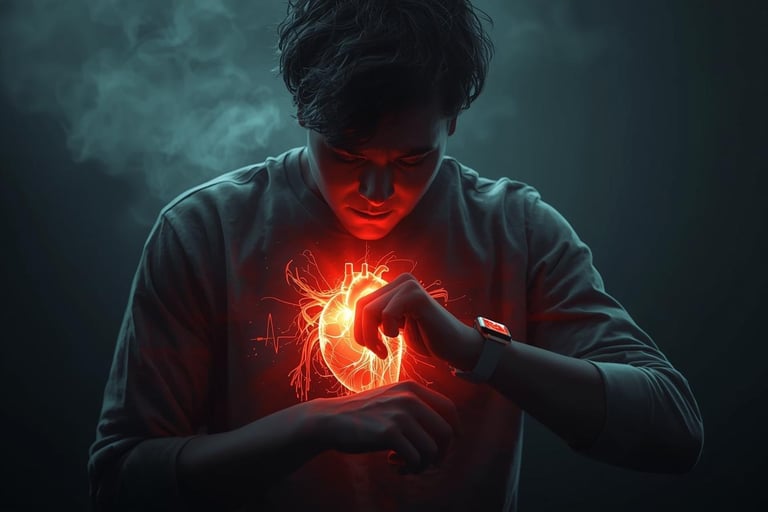
Es martes por la noche. Todo está en silencio, pero dentro de tu pecho hay una fiesta rave a la que no fuiste invitado. Tu corazón late rápido. Demasiado rápido.
Miras tu reloj inteligente: 105 pulsaciones por minuto. Te asustas. Sube a 110.
Lo primero que piensas es: "Algo anda mal. ¿Y si esta vez es un ataque al corazón?"
Te han dicho mil veces que "es solo ansiedad". Te han dicho que "respires profundo". Pero cuando sientes que el motor de tu vida se acelera sin permiso, ninguna frase motivacional funciona.
Hoy quiero hacerte una pregunta diferente. Una pregunta que quizás cambie tu relación con esas palpitaciones para siempre:
¿Y si tu corazón no está "loco"? ¿Y si, en realidad, tu cuerpo está tratando de protegerte de una amenaza que tú no ves, pero que tu cerebro aprendió a temer?
It's Tuesday night. Everything is quiet, but inside your chest, there’s a rave party you weren't invited to. Your heart beats fast. Too fast.
You look at your smartwatch: 105 beats per minute. You get scared. It goes up to 110.
The first thing you think is: "Something is wrong. What if this time it’s a heart attack?"
You've been told a thousand times that "it's just anxiety." You've been told to "breathe deeply." But when you feel the engine of your life racing without permission, no motivational quote works.
Today I want to ask you a different question. A question that might change your relationship with those palpitations forever:
What if your heart isn't "crazy"? What if, actually, your body is trying to protect you from a threat you don't see, but your brain learned to fear?

The Heart That Won't Rest: Anxiety or Your Body Protecting You?
Por Scarlett Rodríguez | 5 min de lectura
La Trampa del "Control"
The "Control" Trap
Vamos a usar la ciencia para entender esto. Específicamente, el Análisis Funcional de la Conducta.
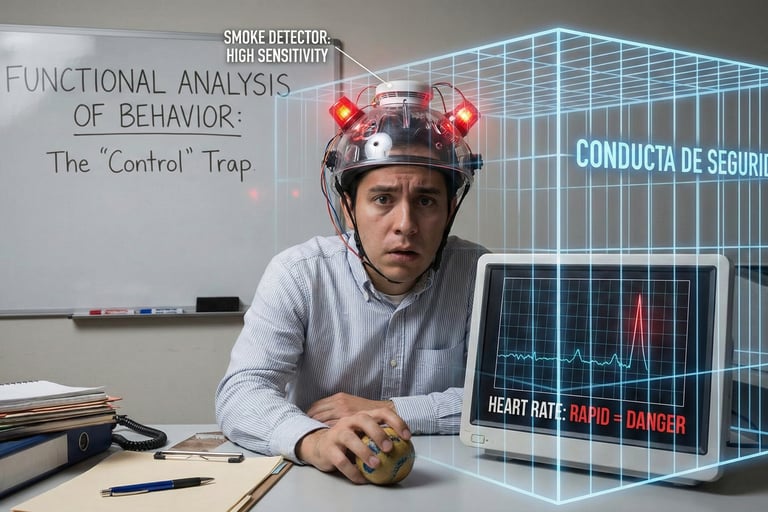
Imagina que tu cerebro funciona como un detector de humo muy sensible. Hace tres meses, quizás tuviste un momento de estrés intenso, o quizás solo te tomaste un café muy cargado. Tu corazón se aceleró. Te asustaste.
En ese momento, tu cerebro grabó un mensaje peligroso:
"Pulsaciones rápidas = PELIGRO DE MUERTE".
Desde ese día, has desarrollado un ritual. Un ritual que haces para sentirte "seguro", pero que en realidad mantiene vivo el miedo. Lo llamamos Conducta de Seguridad.
Let's use science to understand this. Specifically, the Functional Analysis of Behavior.
Imagine your brain works like a very sensitive smoke detector. Three months ago, maybe you had a moment of intense stress, or maybe you just had a very strong coffee. Your heart raced. You got scared.
At that moment, your brain recorded a dangerous message:
"Fast heart rate = DANGER OF DEATH."
Since that day, you have developed a ritual. A ritual you do to feel "safe," but which actually keeps the fear alive. We call it Safety Behavior.
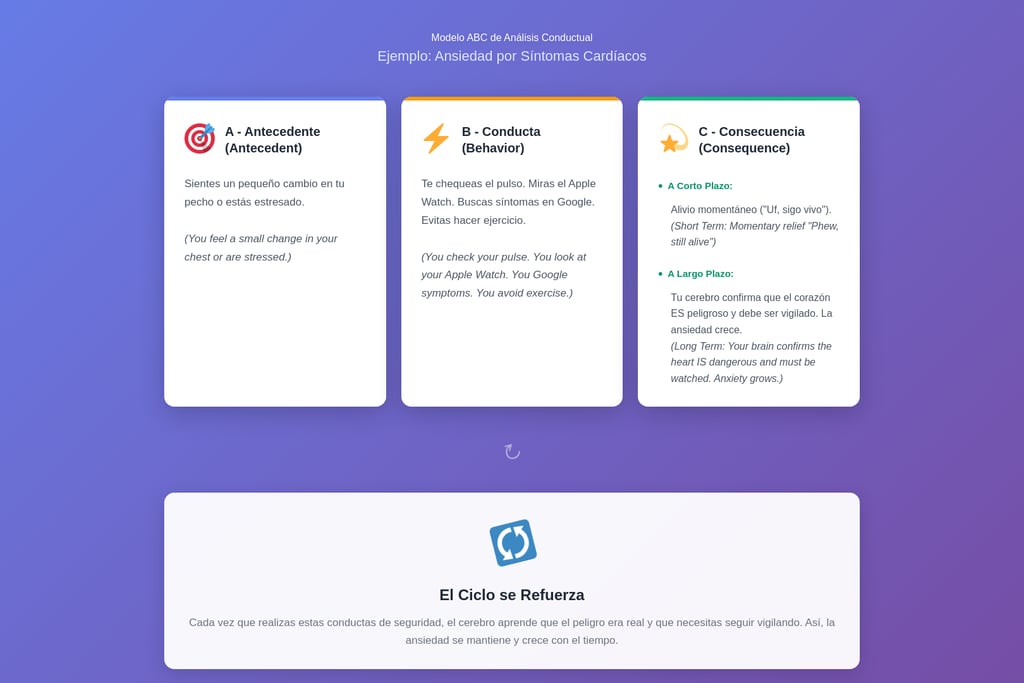
u Análisis Funcional (El Modelo A-B-C)
Your Functional Analysis (The A-B-C Model)
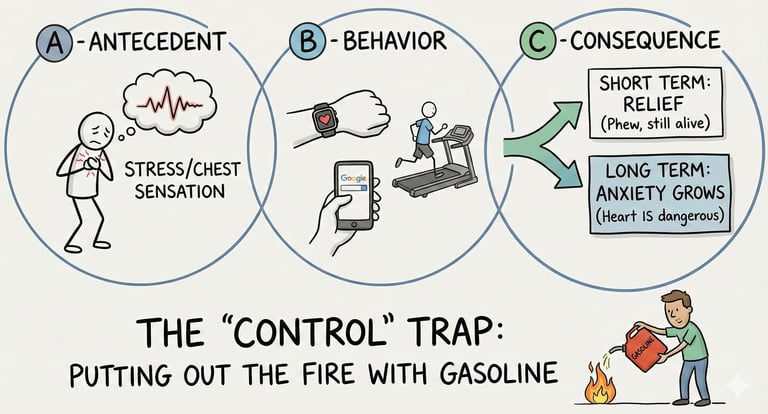
Mira si te reconoces en este patrón. Es lo que mantiene tus palpitaciones vivas:
Check if you recognize yourself in this pattern. It is what keeps your palpitations alive:
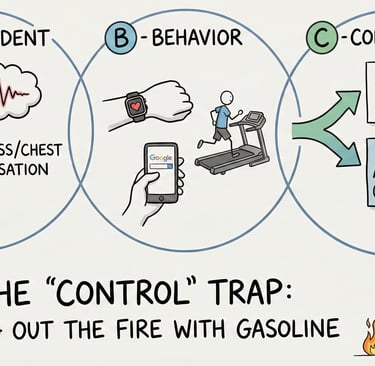
¿Ves la trampa?
Cada vez que revisas tu pulso para "calmarte", le estás enseñando a tu sistema nervioso que tu propio corazón es una amenaza que debe ser monitoreada.
Estás apagando el fuego con gasolina.
Do you see the trap?
Every time you check your pulse to "calm down," you are teaching your nervous system that your own heart is a threat that must be monitored.
You are putting out the fire with gasoline.

No Es Tu Corazón, Es Tu Foco
It's Not Your Heart, It's Your Focus
En la Terapia de Aceptación y Compromiso (ACT), hablamos de un concepto clave: la lucha contra la experiencia interna.
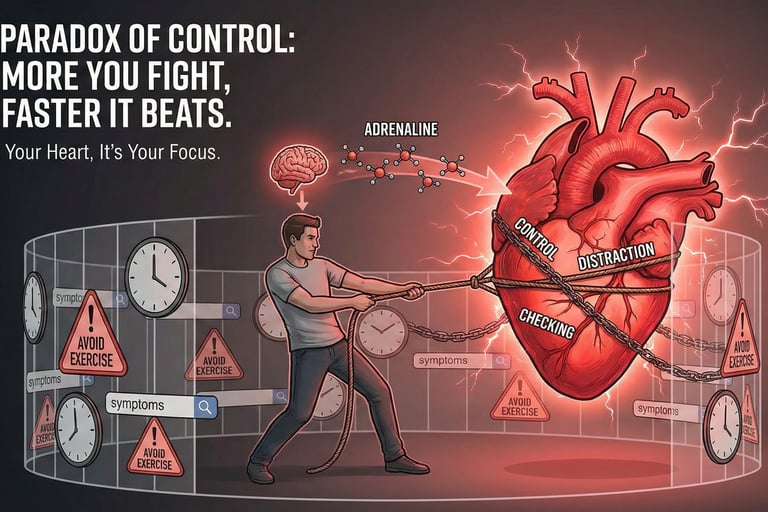
Cuando intentas controlar un latido (respirando forzadamente, distrayéndote, chequeando), le envías una señal de alerta al cerebro. El cerebro responde liberando más adrenalina. Más adrenalina = corazón más rápido.
Es una paradoja cruel: Cuanto más intentas frenar tu corazón, más rápido late.
El problema no son las palpitaciones. Las palpitaciones son solo ruido eléctrico. El problema es que has organizado tu vida alrededor del miedo a tenerlas.
In Acceptance and Commitment Therapy (ACT), we talk about a key concept: the struggle against internal experience.
When you try to control a heartbeat (breathing forcibly, distracting yourself, checking), you send an alert signal to the brain. The brain responds by releasing more adrenaline. More adrenaline = faster heart.
It is a cruel paradox: The more you try to slow down your heart, the faster it beats.
The problem isn't the palpitations. Palpitations are just electrical noise. The problem is that you have organized your life around the fear of having them.
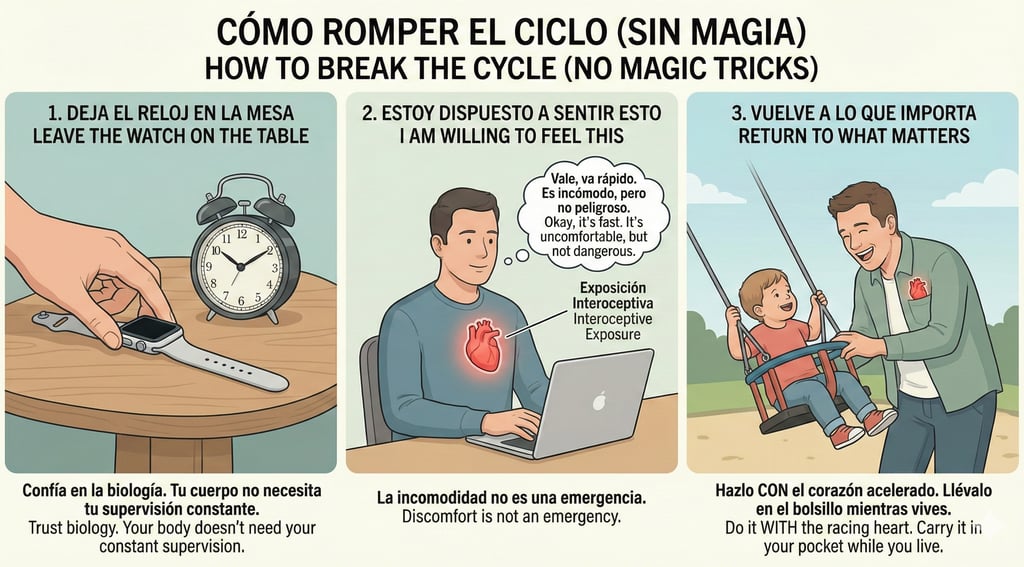
Cómo Romper El Ciclo (Sin Magia)
How to Break The Cycle (No Magic Tricks)
No te voy a decir que "pienses positivo". Eso no sirve para nada aquí. Te voy a invitar a hacer algo contraintuitivo, basado en la evidencia científica.
I'm not going to tell you to "think positive." That's useless here. I'm going to invite you to do something counterintuitive, based on scientific evidence.
1. Deja el reloj en la mesa
Leave the watch on the table
Si usas un smartwatch para medir tu estrés o pulso, quítatelo. Hoy. Ahora.
La información constante alimenta la hipervigilancia. Tu cuerpo sabe bombear sangre sin que tú lo supervises. Confía en la biología.
If you use a smartwatch to measure your stress or pulse, take it off. Today. Now.
Constant information feeds hypervigilance. Your body knows how to pump blood without you supervising it. Trust biology.
2. Cambia el "Tengo que calmarme" por "Estoy dispuesto a sentir esto"
Switch "I have to calm down" to "I am willing to feel this"
La próxima vez que el corazón se acelere, no corras a respirar profundo. Quédate quieto. Nota la sensación. Dile a tu cerebro:
"Vale, mi corazón va rápido. Es incómodo, sí. Pero no es peligroso. Puedo seguir escribiendo este correo (o lavando los platos) con el corazón rápido."
Esto se llama Exposición Interoceptiva. Le enseñas a tu cerebro que la sensación física no es una emergencia.
Next time your heart races, don't run to breathe deeply. Stay still. Notice the sensation. Tell your brain:
"Okay, my heart is going fast. It's uncomfortable, yes. But it's not dangerous. I can keep writing this email (or washing the dishes) with a fast heart."
This is called Interoceptive Exposure. You teach your brain that the physical sensation is not an emergency.
3. Vuelve a lo que importa
Return to what matters
Pregúntate: Si no tuviera miedo a estas palpitaciones, ¿qué estaría haciendo ahora mismo?
¿Jugando con tus hijos? ¿Trabajando en ese proyecto? ¿Saliendo a cenar?
Haz eso. Hazlo CON el corazón acelerado. Llévalo contigo en el bolsillo.
Ask yourself: If I weren't afraid of these palpitations, what would I be doing right now?
Playing with your kids? Working on that project? Going out for dinner?
Do that. Do it WITH the racing heart. Carry it with you in your pocket.
Conclusión: Tu Corazón es Fuerte
Tu corazón late unas 100,000 veces al día. Está diseñado para acelerarse cuando te emocionas, cuando corres, cuando te enamoras y sí, cuando te asustas.
No necesitas "arreglar" tu ritmo cardíaco. Necesitas arreglar tu relación con el miedo.
Deja de monitorear. Empieza a vivir.
¿Te sientes identificado con este ciclo de vigilancia y miedo?
Si llegaste hasta aquí, reconociste tu patrón. Y eso es el primer paso.
Pero reconocer no es suficiente. El cambio ocurre cuando actúas diferente.
No tienes que hacerlo solo.
🚀 El Próximo Paso: Sesión Individual
Una consulta de 50 minutos donde analizamos TU patrón A-B-C específico, entendemos qué mantiene vivas esas palpitaciones, y diseñamos los primeros pasos concretos hacia el cambio.
Conoce a Nuestro Equipo y agenda una cita
Si quieres conocer más sobre cada terapeuta, disponibilidad e idiomas:
👉
Tu corazón está bien. Solo necesita entender que está a salvo.
Conclusion: Your Heart is Strong
Your heart beats about 100,000 times a day. It is designed to speed up when you get excited, when you run, when you fall in love, and yes, when you get scared.
You don't need to "fix" your heart rate. You need to fix your relationship with fear.
Stop monitoring. Start living.
Do you identify with this cycle of vigilance and fear?
If you made it this far, you recognized your pattern. And that's the first step.
But recognizing isn't enough. Change happens when you act differently.
You don't have to do it alone.
🚀 Next Step: Individual Session
A 50-minute consultation where we analyze YOUR specific A-B-C pattern, understand exactly what keeps those palpitations alive, and design concrete first steps toward change.
If you want to learn more about each therapist, availability and languages:
Your heart is fine. It just needs to understand it is safe.
What's your next step?