

You architect billion-dollar strategies. You navigate markets that destroy average competitors. Yet a relationship that ended months ago still commands prime neural real estate—extracting what executives value most: cognitive bandwidth.
At Plenitud, we don’t pathologize heartbreak. We audit it. Through Functional Behavior Analysis, we’ve identified why high-achievers get trapped in post-breakup rumination longer than anyone else.
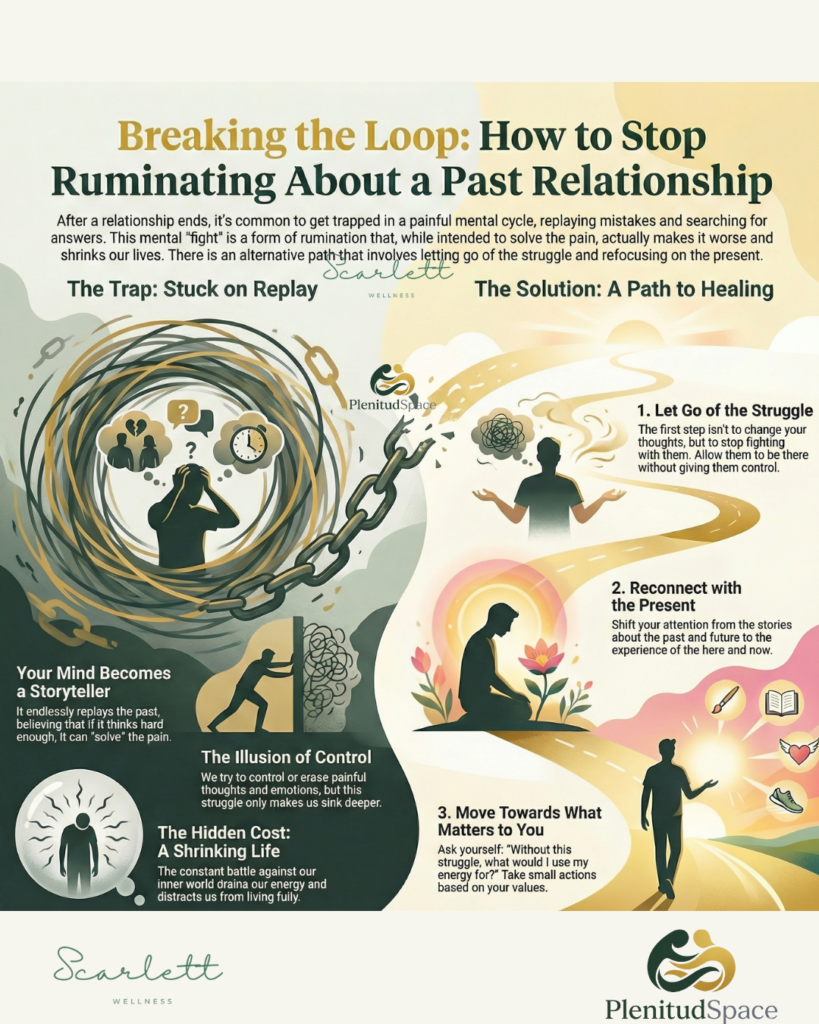
The Paradox: Your Greatest Strength Is Your Trap
Your problem-solving apparatus—the same neural circuitry that built your career—has turned against you. When relationships fail, that machine doesn’t shut down. It accelerates.
According to Skinner’s analysis of verbal behavior, your rumination operates as covert verbal operant behavior maintained by automatic reinforcement. Translation: Your brain has learned that analyzing the past temporarily reduces emotional discomfort. Each mental replay provides micro-relief—enough to keep the loop running indefinitely.
This isn’t weakness. It’s behavioral momentum—the same persistence that makes you unstoppable in business now locks you in cognitive purgatory.
The Functional Analysis: Three Maintaining Contingencies
Through behavioral assessment, we identify the hidden reinforcement structure:
Negative Reinforcement Through Experiential Avoidance
Analysis feels productive. It’s cognitive work. As long as you’re dissecting the past, you postpone the terrifying uncertainty of a future without that person. The behavior is maintained not by what it achieves, but by what it prevents—the unbearable present moment.
Relational Frame Rigidity
Per Relational Frame Theory, you’re responding to derived relational networks that no longer map reality. The frame “understanding why = closure” creates a verbal rule you can’t violate. You’re not running old software—you’re trapped in a self-constructed verbal maze where all paths lead back to analysis.
Perfectionism as Behavioral Inflexibility
Your refusal to accept an “imperfect” narrative maintains the loop. In Process-Based Therapy terms, this is psychological rigidity—the inability to persist in value-directed behavior when internal experiences are uncomfortable.
The Three Hidden Pillars Keeping You Anchored
The Illusion of Control. Ruminating feels like “working” on the problem. It masquerades as problem-solving while actually functioning as experiential avoidance. As long as you’re analyzing the past, you don’t have to face the terrifying uncertainty of a present without that person. You believe control over the narrative equals emotional safety. You’re wrong.
Cognitive Rigidity Through Derived Relations. Your identity became fused to relational frames that no longer serve you. The “rule” you constructed—”If I understand why, then I can move forward”—is now a prison. Every attempt to “solve” the relationship through analysis reinforces the frame. You’re not thinking about the relationship; you’re responding to a linguistic trap of your own making.
The Perfectionist Tax. The refusal to accept a “flawed” ending keeps you in constant mental re-editing. The ending wasn’t supposed to be like this. There must be missing information. One more analysis, one more review of the past, and the conclusion will finally feel acceptable. It won’t. The pursuit of a “perfect” narrative is the mechanism that keeps you stuck.
The Cost You’re Not Calculating
If your mental energy were a financial portfolio, you would have liquidated this “loss-making” relationship months ago. Yet you continue allocating executive function to a position that generates zero return.
Consider what rumination costs you:
- Attention tax: The cognitive load of constant background processing
- Decision-making impairment: Emotional drainage reduces your strategic clarity at work
- Relationship forfeit: Present relationships suffer because your capacity is consumed by a past one
- Sleep disruption: The verbal loop activates at 3 AM, fragmenting recovery
- Present-moment poverty: You’re functionally absent from your own life
From Analysis to Action: The Process-Based Solution
We don’t offer closure. We offer functional flexibility.
Process-Based Therapy (PBT) doesn’t target thoughts or feelings—it targets the behavioral repertoire that keeps you stuck. Using the Extended Evolutionary Meta Model, we identify which psychological processes are inflexible and build competing behavioral patterns.
The Intervention Targets:
Desfusion Protocols. Learn to observe thoughts without treating them as commands requiring action. The thought “I need to understand why” becomes what it actually is: a linguistic artifact, not a truth claim demanding investigation.
Values Clarification. Redirect cognitive resources toward behaviors aligned with your chosen life directions—not the ones dictated by rumination. What do you actually want to build? That question matters more than why the last relationship ended.
Acceptance Training. Build tolerance for emotional discomfort without escape behaviors. You can feel sadness without analyzing it. You can experience uncertainty without solving it. These are skills, not character flaws.
Present-Moment Anchoring. Develop attentional control that competes with rumination. Your body is here. Your business is here. Your future is here. Your past relationship exists only in language.
The Executive Recalibration
Your past is a closed data set. The relationship has ended. No amount of analysis will change that terminal fact. If this were an underperforming asset in your portfolio, you would have liquidated it immediately and reallocated capital to growth opportunities.
Yet you continue deploying your most finite resource—your attention—to a position that cannot generate returns.
True plenitud isn’t about “getting over it”—it’s about behavioral reallocation. It’s the capacity to contact present-moment contingencies without being governed by historical verbal networks. It’s the ability to walk into your future without the weight of a narrative that no longer serves you.
It is the shift from being the story to being the architect of the experience.
Elite Pathways to Reclaim Your Sovereignty
The Functional Assessment
One-on-one behavioral case formulation. We map your specific antecedents, behaviors, and maintaining consequences. We identify which psychological processes are inflexible. We don’t ask “How do you feel about the relationship?” We ask “What function does rumination serve, and what competing behaviors will displace it?”
This is precision behavioral engineering, not talk therapy.
The Flexibility Intensive
Executive-level training in psychological flexibility protocols. Learn to implement ACT and PBT interventions in real-time. Develop a behavioral toolkit for managing cognitive capture. Understand the neuroscience of rumination and the behavioral mechanisms that interrupt it.
This is the same rigor you apply to business strategy, applied to your inner life.
Your Empire Deserves Your Full Presence
Stop paying rent to a ghost. Your cognitive capital is finite. Your attention is your most valuable asset. Every moment spent in rumination is a moment stolen from strategy, from relationships, from building.
The doors to our high-resource ecosystem are open for those ready to transition from analysis to mastery.
[SCHEDULE YOUR FUNCTIONAL ASSESSMENT]
[APPLY FOR THE FLEXIBILITY INTENSIVE]
Your past is a data set, not a life sentence. It is time to reclaim your sovereignty.